
How to Check Criminal History in Martin County
The Martin Clerk Court Records Search is the best first stop for a local prosecution. It covers Circuit Court felony files and County Court misdemeanor, criminal traffic, and ordinance files. Search by party name or case number, then check the filing date, division, status, and charge data before opening a docket. A full name, middle name, spelling variants, and an approximate date help separate people who share a surname.
No one source is a complete Martin County criminal history. The Sheriff answers booking and report questions, the Clerk shows the court outcome, FDLE returns public Florida history, and FDC covers state prison or supervision. Use the source that created the record.
Start with the narrowest question. A person trying to understand a Martin County case should save the case number and inspect the final docket entries. Someone reviewing a recent jail event should record the booking number and arresting agency before requesting the affidavit. For an older Florida-wide self-check, fingerprints avoid many name-match problems. These identifiers make later calls and written requests far more precise.
- Search the Martin Clerk docket for criminal cases by party or case number.
- Check MCSO Recent Bookings and call the jail when present custody matters.
- Request the incident or arrest report from the agency that wrote it.
- Compare charges on the docket with the final judgment and disposition.
- Order a certified Clerk copy or an FDLE product when an official result is needed.
Martin County's Four Record Layers
Martin County records split across four layers. MCSO creates sheriff reports and the county jail booking file. The Martin County Clerk records the prosecution, motions, judgment, and sentence. FDLE receives fingerprint arrests and reported dispositions for the statewide history. FDC takes over when a sentence leads to state prison or state community supervision. The same event can appear in each system at a different time and with different charge text.
The Martin County Sheriff's Office homepage points to jail and report services. Its layout shows why county custody and court outcomes must be checked apart.
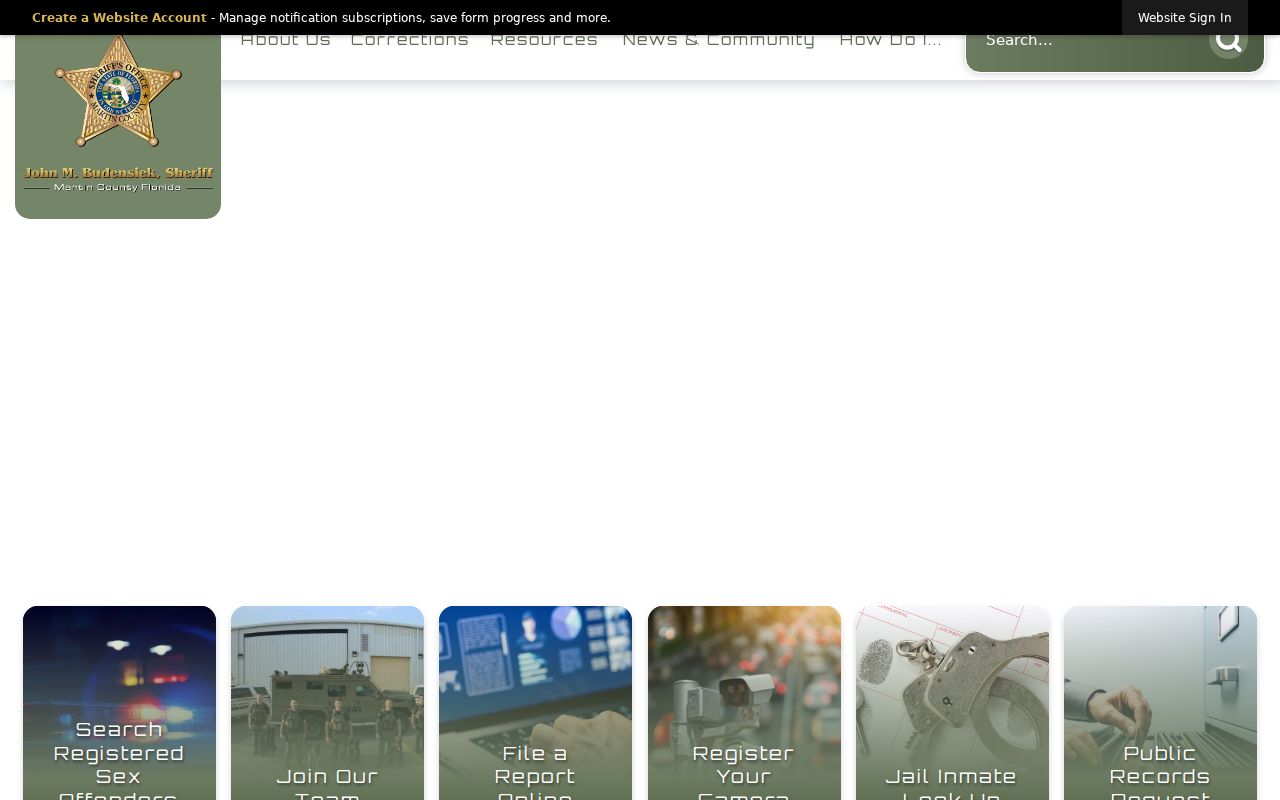
Use the Clerk for the filed case, FDLE for public statewide history, and FDC only after state custody or supervision becomes relevant.
Timing explains many apparent conflicts. A Martin County booking can appear before the State Attorney files an information. The Clerk docket can then show a reduced charge while the first arrest label remains in the jail or FDLE record. Disposition reporting may follow later. Compare dates and record owners instead of assuming that one screen has replaced all earlier entries.
Record flow: Arresting agency › Martin County Jail › State Attorney › Martin County Clerk › FDLE › FDC when sentenced.
Official Florida Background Checks
The Florida Department of Law Enforcement offers three official routes. Instant Search is a demographic name check with a printable, non-certified result. It costs $24 plus a $1 card fee. The staff-processed certified or non-certified search costs $24 and returns by mail after the posted processing period. ORI Search is reserved for a purpose and recipient authorized by law, using an ORI supplied by that agency.
The FDLE options page sets out those products and their limits.
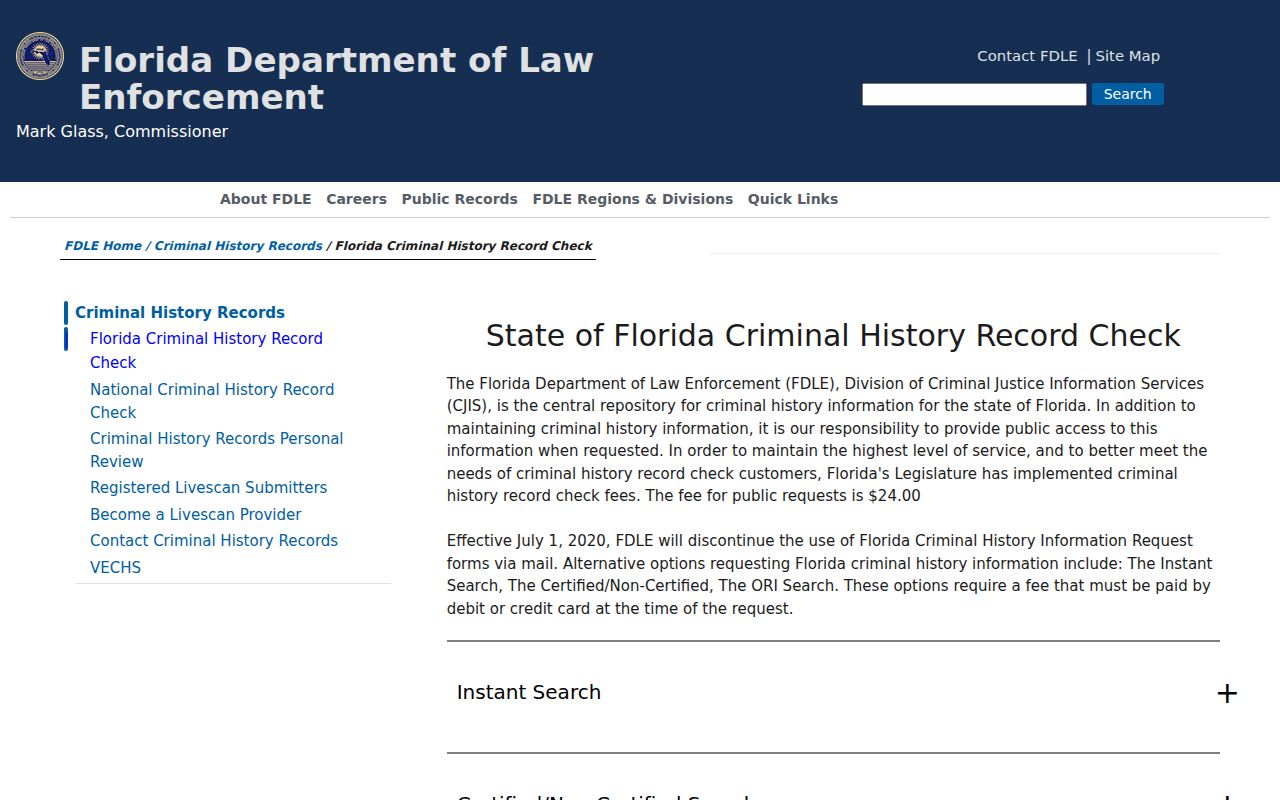
For self-review, FDLE's free Personal Review uses fingerprints and supports a challenge to incomplete or inaccurate state repository data.
Martin County residents may ask MCSO about fingerprinting at the Monterey Road office or choose an FDLE-listed Livescan provider when an authorized agency supplies an ORI. The ORI states the legal purpose and where results go. FDLE will not invent or select that code for the requester. A Personal Review uses a different process: fingerprints may be taken by a law-enforcement or criminal-justice agency and mailed with the FDLE form.
| Channel | Best use | Cost |
|---|---|---|
| FDLE Instant Search | Fast public Florida name search | $24 plus $1 card fee |
| FDLE staff search | Certified or non-certified mail result | $24 |
| Personal Review | Fingerprint review of your own record | Free |
Search Martin County Court Records
The Martin County Clerk separates Court Records from Official Records. Criminal dockets belong in Court Records. The search can use a party name or case number, with category and date controls to narrow common names. Results may show the case number, filing date, division, judge, status, charge counts, docket events, disposition, and financial entries. Public document images vary because confidential and role-limited material stays restricted.
The Clerk's records search page identifies the portal and other request routes.
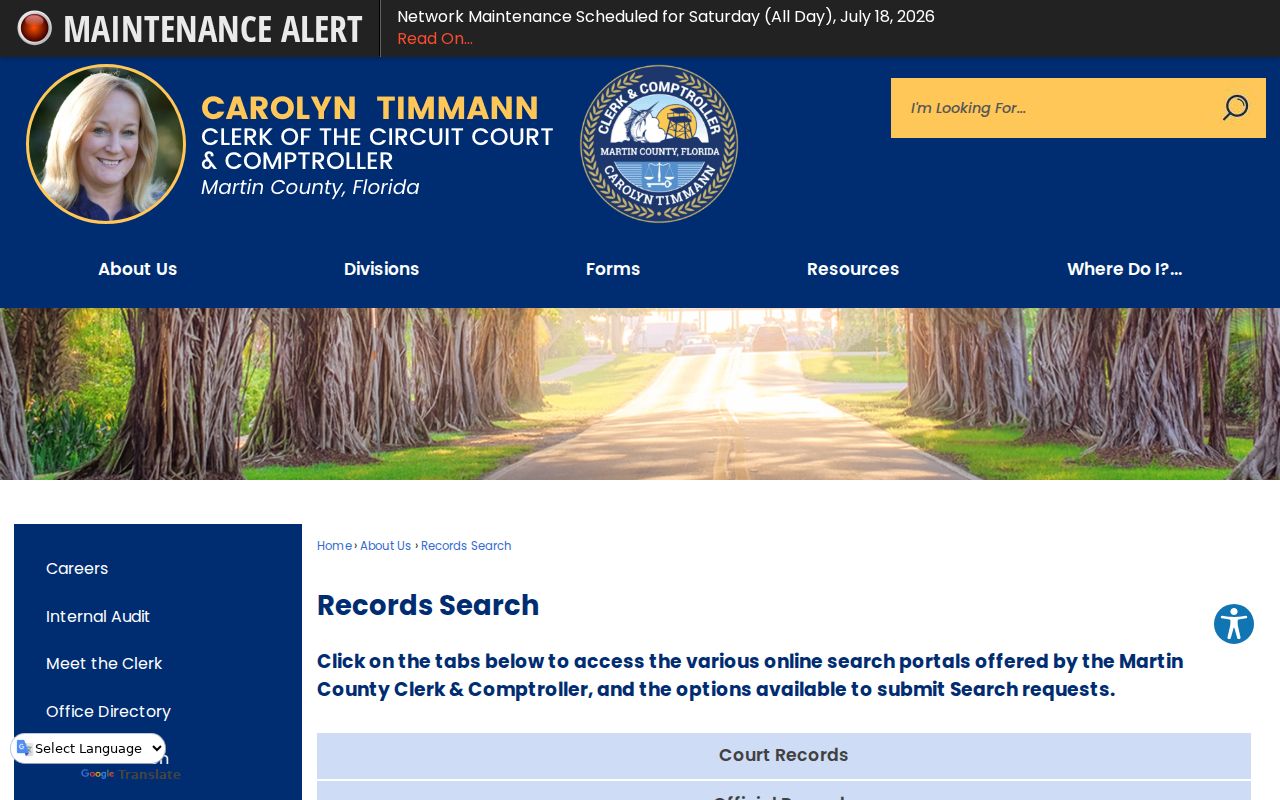
If the online image is missing, request it by web form, mail, email, counter, phone, or fax. A missing image does not mean the case never existed.
| Search field | How it helps |
|---|---|
| Last and first name | Finds party matches; try spelling variants. |
| Middle name | Separates common names. |
| Case number | Goes to the known local file. |
| Case category | Limits results to criminal or traffic records. |
| Filing dates | Narrows the time window. |
Types of Martin County Criminal Records
Each Martin County record describes one stage of the justice process. A police report states allegations and officer action. A jail booking documents intake and custody. The State Attorney's information states the charges chosen for prosecution. The Clerk file shows hearings and the outcome. FDLE assembles reported Florida arrest cycles and dispositions, while FDC maintains state prison and community-supervision records.
- Incident and arrest reports: kept by MCSO, Stuart Police, Sewall's Point Police, or the agency that wrote the report.
- Booking records: created by Martin County Jail after intake.
- Court case files: maintained by the Martin County Clerk for Circuit and County Court.
- Warrant records: issued by a court and verified through the Clerk and law enforcement.
- State records: FDLE holds Florida history, and FDC holds state custody and supervision data.
Martin Sheriff Records and Jail
The MCSO Records Unit at 800 SE Monterey Road in Stuart is the report-level fallback. Its counter is open weekdays from 8 a.m. to 5 p.m.; call 772-220-7050. Requests begin through the MCSO JustFOIA portal, or may be mailed with a self-addressed stamped envelope. The request should identify the approximate date, place, case or booking number, record type, and preferred format. The portal supplies a request number and security key for tracking.
The official Clerk and Comptroller home page complements MCSO by routing readers to court records rather than sheriff reports.
Martin County court copies cost $1 per page plus $2 certification per document. Sheriff production costs can apply, including a reasonable special service charge for extensive use under Chapter 119.
The Clerk also accepts court-record requests by email at RecordRequest@martinclerk.com, by mail to PO Box 9016 in Stuart, at the first-floor counter, by phone, and by fax. Older court audio follows a separate route. MCSO says sheriff requests are not currently fulfilled by fax even though a Records Unit fax is listed for contact. Choosing the right channel avoids sending a police narrative request to the court or a certified judgment request to the Sheriff.
MCSO Records Unit
800 SE Monterey Road
Stuart, FL 34994
772-220-7050
Weekdays, 8 a.m.-5 p.m.
Clerk Criminal Division
100 SE Ocean Boulevard, first floor
Stuart, FL 34994
772-288-5576
What a Martin County Criminal Record Shows
A Martin County criminal record may connect identity data to an arrest cycle, charge, docket, disposition, sentence, and custody status. Read the source label before drawing a conclusion. A booking charge is preliminary. A filed charge reflects the prosecutor's decision. A judgment records what the court resolved. Protected victim data, juvenile material, account numbers, and sealed information do not appear in public views.
| Name & Identifiers | Name, aliases, date of birth, and agency identifiers where public. |
|---|---|
| Arrest / Booking Data | Agency, date, booking number, alleged charge, bond, and release status. |
| Charges & Statutes | Counts filed, offense text, and cited Florida law. |
| Disposition | Conviction, dismissal, acquittal, nolle prosequi, or withhold. |
| Sentence | Custody, probation, fines, costs, restitution, and conditions. |
| Custody / Supervision | County jail, FDC prison, or community-supervision status. |
Martin County's Ten-Day Booking Window
The MCSO Recent Bookings page covers only the last ten days. It is not a historical arrest archive. Weekend and holiday affidavits may wait until the next business day, and a person can be released before the page is checked. Call the jail information line at 772-220-7220 when present custody must be confirmed.
For a wider self-check, the FDLE Personal Review page explains the fingerprint review and correction route.
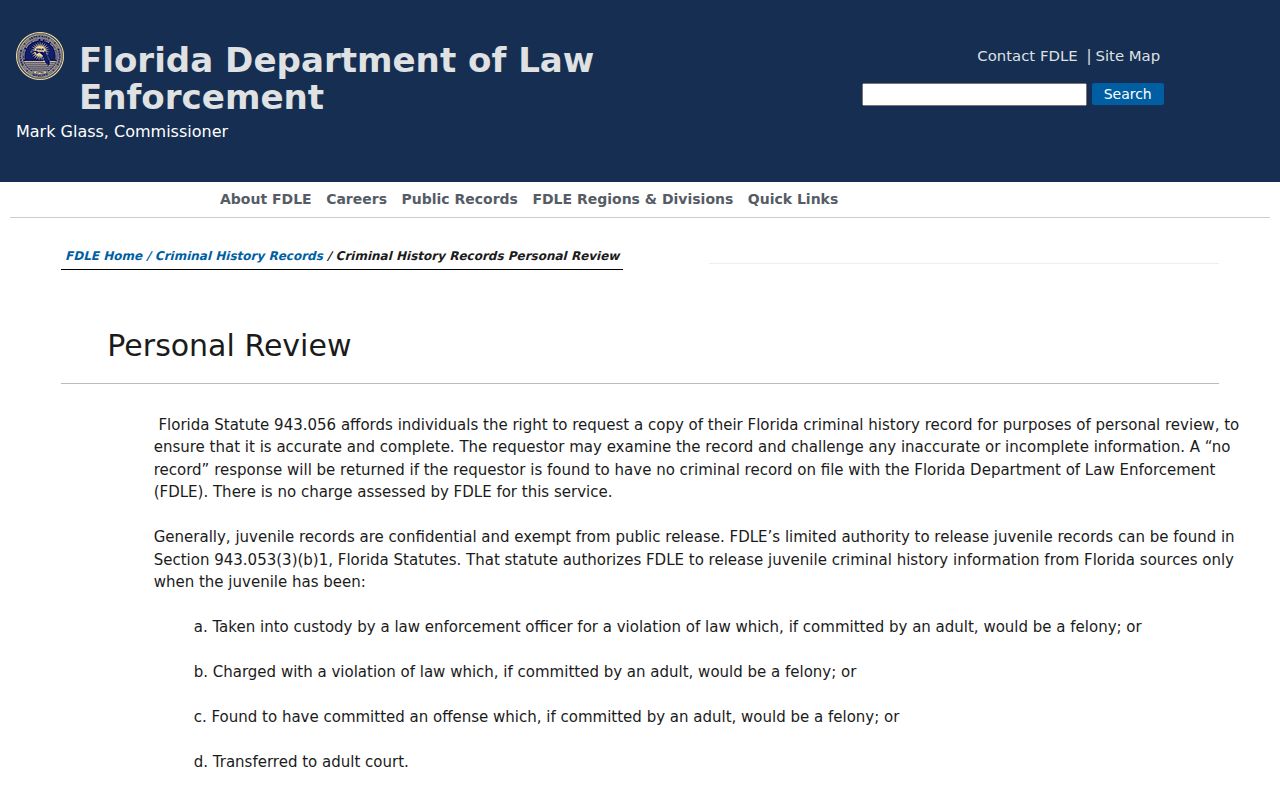
That state self-review is not a substitute for the short MCSO feed, but it helps when an older arrest entry appears incomplete or tied to the wrong person. For an older Martin County arrest, request the source report, search the Clerk docket, and use FDLE for the statewide history. The Martin County arrest history route explains each channel in more depth.
Public Access Laws for Martin County Criminal Records
Florida Public Records Law lets a person inspect and copy nonexempt agency records without stating a reason or giving a name. Judicial records follow Florida Rule of General Practice and Judicial Administration 2.420 instead of the sheriff's routine Chapter 119 process. Access does not override protection for victims, juveniles, active investigations, sealed cases, or private identifiers.
A narrow Martin County request is easier to review and price. Give the custodian an incident date or range, location, agency case number, and the exact material sought, such as an arrest affidavit, CAD chronology, audio, or photographs. Contact details are not generally required to invoke Chapter 119, though they help the office send an estimate and deliver records. Those details may themselves become public records.
Key Florida authorities:
Section 119.07 gives inspection and copy rights for nonexempt agency records.
Section 943.053 authorizes FDLE to disseminate public Florida criminal history.
Rule 2.420 governs public access and confidentiality for court records.
Section 943.059 controls court-ordered sealing and retained agency access.
Martin Jail or Florida Prison
Use the Martin County Jail tools for a recent arrest or pretrial detention. Use the FDC Offender Search after a state prison sentence or for Florida community supervision. A person awaiting trial at the county jail may not appear in FDC. Federal custody belongs in the Bureau of Prisons locator, not either Florida source.
The FDC search screen is the state layer for prison and supervision records.
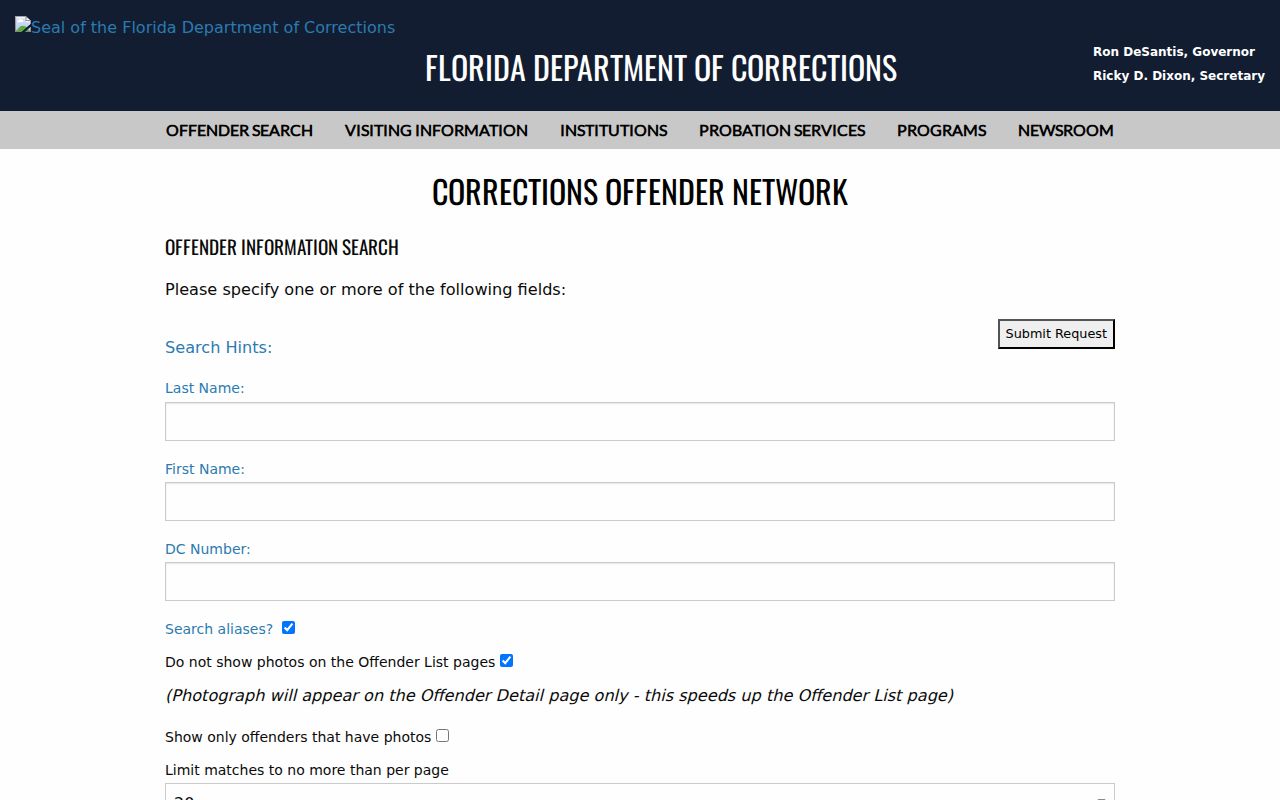
The sentencing docket remains the best place to identify whether FDC or a misdemeanor provider supervises the case.
Sealed, Expunged, and Restricted Records
Florida restricts juvenile records, protected victim information, sealed cases, account data, and other exempt material. Court-ordered sealing blocks public access while named agencies retain statutory access. Expungement removes qualifying agency records to the extent set by law, but specified government access remains. A dismissal or acquittal does not erase an arrest on its own.
The Martin County route starts with a certified final disposition and the FDLE Certificate of Eligibility process. FDLE currently posts about a 12-week eligibility review with no expedite. The certificate permits a petition; it is not a court order. The petition then goes to the Martin court with jurisdiction, with service on the State Attorney and other agencies as required.
The FDLE seal and expunge page lists the available forms and relief types.
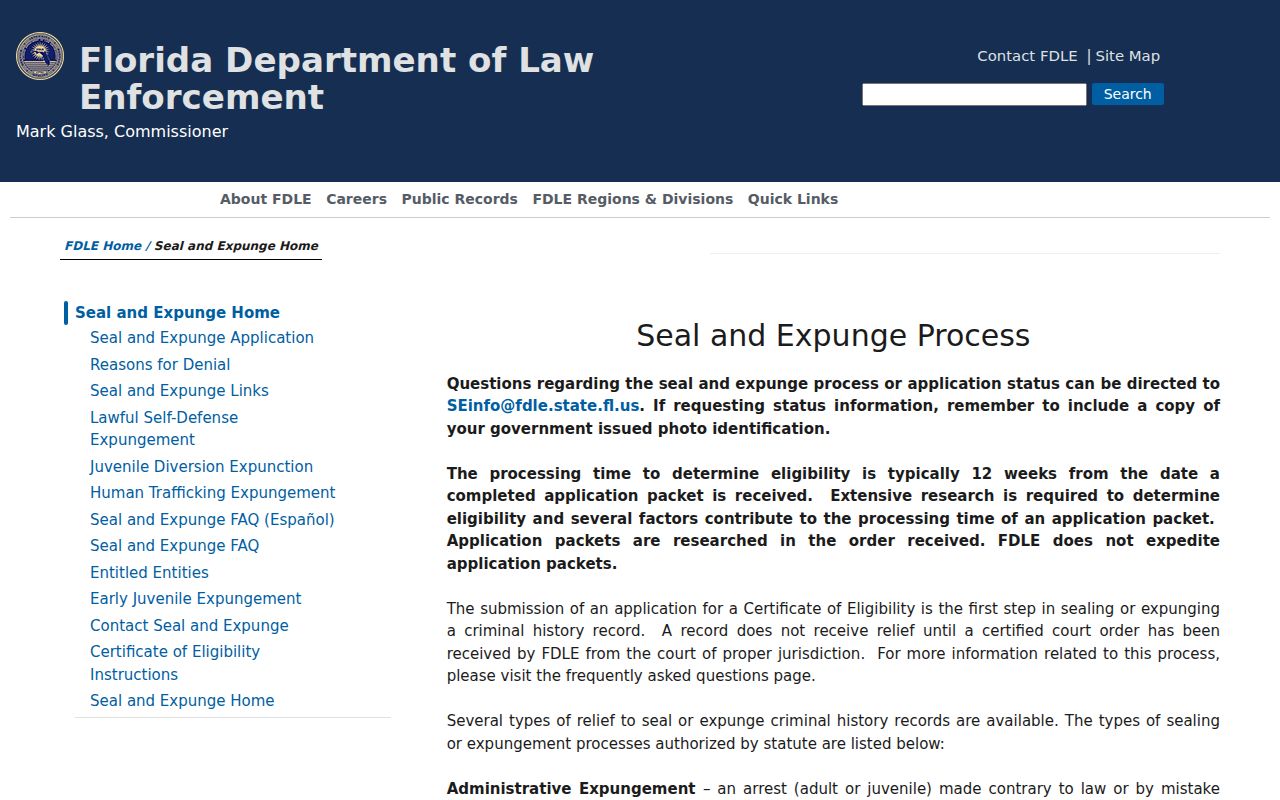
Automatic sealing under section 943.0595 applies at the state repository level and does not seal the local Martin County court file. Check both sources after relief.
Before filing, preserve the arrest report and certified final disposition. Eligibility depends on the result, prior adjudications or relief, and whether the offense is barred. Florida generally allows one court-ordered seal or expungement in a lifetime, subject to statutory exceptions. Separate paths exist for an arrest made by mistake, certain trafficking survivors, lawful self-defense cases, and qualifying juvenile records.
Read Martin County Case Outcomes
Short docket terms carry very different meanings. A closed case is not always a conviction, and a withhold is not a dismissal. Use the final judgment, not the arrest label, to understand the result.
- Disposition
- The result of a charge, such as conviction, dismissal, acquittal, or nolle prosequi.
- Nolle prosequi
- The State Attorney's formal decision not to proceed on that charge at that time.
- Withhold of adjudication
- A Florida result in which guilt is not formally adjudicated; it is not an acquittal.
- Capias
- A court command to take a person into custody, often tied to a missed appearance or violation.
- Docket
- The dated list of filings, hearings, orders, and case events.
Criminal Records by City in Martin County
Martin County's three largest incorporated places use different local routes. Stuart and Sewall's Point have police departments that retain their own incident reports. Indiantown relies on MCSO for law-enforcement records, while its Village Clerk holds administrative files. All three route prosecutions to the Martin County Clerk rather than a separate city criminal docket.
Stuart Criminal History
20,380 residents · Police reports begin with Stuart Police.
Indiantown Criminal History
6,763 residents · MCSO supplies village law enforcement.
Sewall's Point Criminal History
2,076 residents · Town police retain local reports.
Martin County Justice at 100
Martin County and its Sheriff's Office both marked a centennial in 2025. The official MCSO history traces the agency from appointed Sheriff Bert Babcock through Sheriff John Budensiek, who took office in January 2025 after a long MCSO career. The agency's “A Walk Through Time” event placed old photos and artifacts beside current public-safety equipment.
Today, criminal court work is centered at the Ocean Boulevard courthouse complex, while sheriff reports, fingerprints, bookings, and jail services remain at Monterey Road. The named problem-solving venues in the Nineteenth Judicial Circuit include Adult Felony Drug Court and Mental Health Court. Those programs create their own docket events, but the Martin County Clerk still holds the court file.
For post-prison release authority, the Florida Commission on Offender Review is distinct from FDC supervision.
That separation matters because Florida parole applies mainly to eligible older or specified sentences, not every person leaving state prison.