
How to Check Criminal History in Stuart
Choose the source by the stage of the Stuart matter. The Stuart Police Department retains its own incident and arrest reports. Martin County Sheriff’s Office creates the jail record when a person is booked, and the Martin County Clerk of the Circuit Court and Comptroller maintains the public court docket after a criminal case is filed. FDLE is the statewide layer, not a replacement for fresh local source records. A name-only result may refer to someone else, so compare available identifiers and use fingerprints when positive identification matters.
- Start with the Stuart Police online services and select Police Report Request for a city incident.
- Describe the report precisely with the case number, incident date, location, involved party, and requested record type when known.
- Check MCSO Recent Bookings or call 772-220-7220 for current custody following a Stuart arrest.
- Search the Martin Clerk court portal by party or case number for charges, docket events, and disposition.
- Use FDLE for a broader Florida history or Personal Review of your own repository record.
Stuart City Hall Is Not Police Records
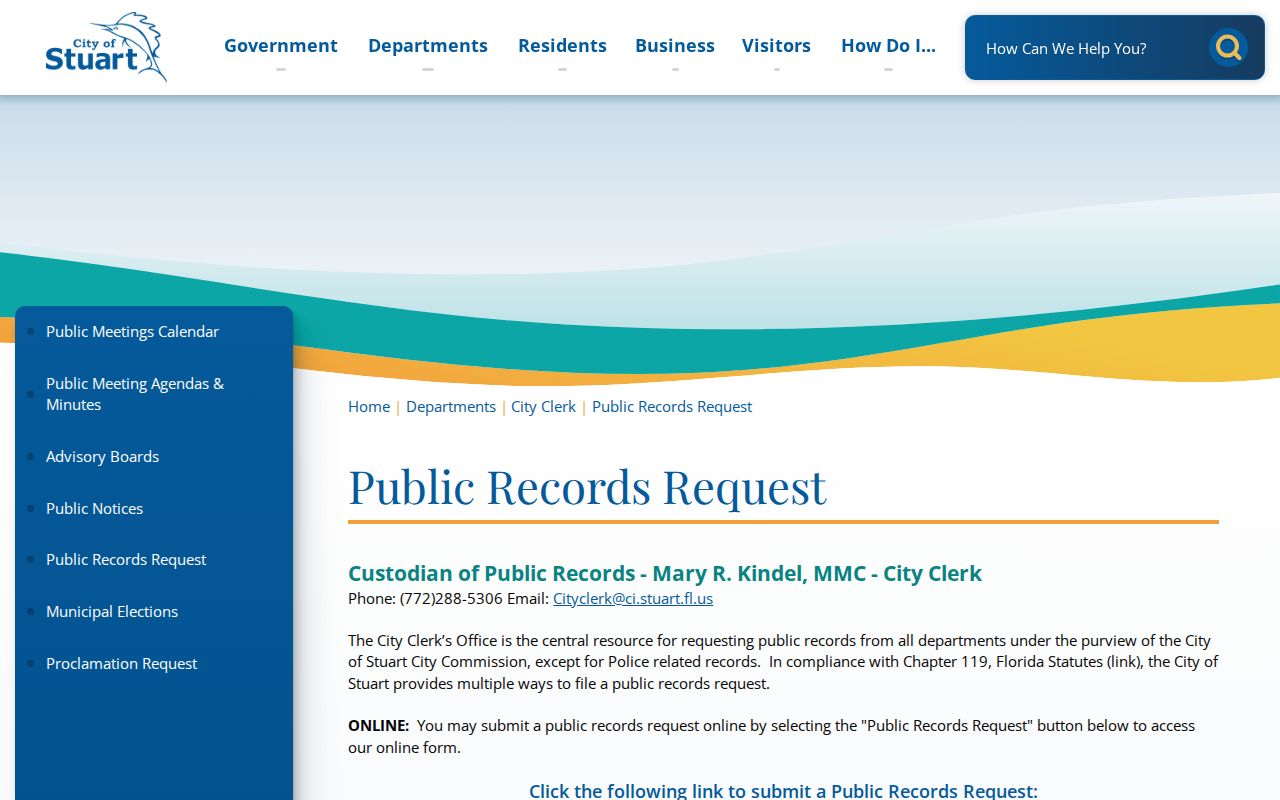
A common Stuart mistake is sending a police request to the City Clerk. Stuart’s central JustFOIA page expressly excludes police-related records. The City Clerk at 121 SW Flagler Avenue handles city administrative material through an online request, email at cityclerk@ci.stuart.fl.us, telephone at 772-288-3599, mail, or counter service during weekday City Hall hours. That channel fits ordinances, meeting records, and other city business, but it is not the criminal-incident file.
For an SPD report, go directly to the Police Report Request route. This distinction matters because Florida public-record law assigns responsibility to the office that created or received the record. A request may be lawful yet still be directed to the wrong custodian. Sending a clear request to SPD avoids a preventable transfer or rejection and preserves the difference between a city administrative file and a police narrative.
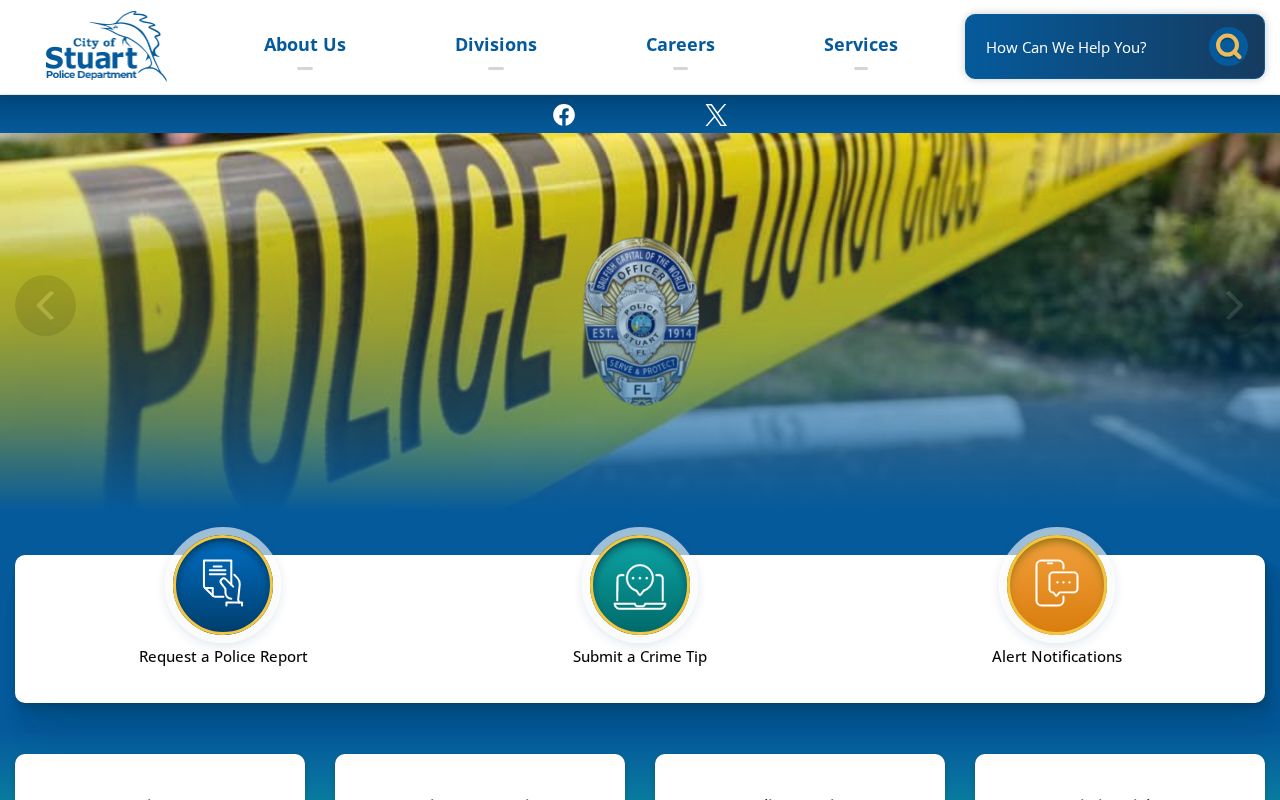
The Stuart Police Department
The Stuart Police Department is located at 830 SE Martin Luther King Jr. Boulevard, Stuart, FL 34994, and its main telephone number is 772-287-1122. Its official directory lists Chief Flamur Zenelovic. SPD Support Services includes Criminal Investigations, accreditation, parking enforcement, and community policing. The Criminal Investigations Division handles serious local matters such as aggravated assault or battery, burglary, robbery, fraud, identity theft, sexual assault, death investigations, and traffic fatalities.
Those operational roles help explain why a single event may create several records. The first report can be joined by supplements, property documentation, photographs, body-camera material, 911 audio, or an arrest affidavit. Request each desired item rather than assuming “the report” includes everything. Victim details, active-investigation material, protected addresses, juvenile information, and personal identifiers may be withheld or redacted under Florida law.
Inside Stuart Police Online Services
SPD’s online-services page groups the Police Report Request with crime tips, emergency alerts, an FDLE registry link, and property-return scheduling. These tools serve different purposes. A tip is not a public-record request, and scheduling return of property is not a way to obtain the underlying case file. Use the report request for a copy, the appropriate service for property, and emergency channels for active danger.
The request form’s exact live labels should be checked before submission because indexed research did not expose every field. Useful details generally include the case or report number, incident date and location, involved party, requester delivery information, and a specific description. Stuart’s official research did not establish a police-report fee, so requesters should seek a current estimate instead of assuming a price.
Stuart Property Return Appointments
SPD lists property-return scheduling separately from report requests because a written record and a physical item follow different processes. A person seeking documentation should request the report or property record. A person entitled to retrieve an item should follow the department’s appointment process and current identification instructions. Access to a report does not authorize release of property.
Before arranging pickup, confirm that the investigating officer, prosecutor, or court has released any hold and ask what proof of ownership or authority is needed. Evidence tied to an open matter may remain unavailable even when part of the report is public. If a docket order directs return or forfeiture, preserve the case number and follow SPD’s instructions. Keeping these routes separate prevents a records request from being mistaken for a release authorization.
Arrests and Bookings in Stuart
SPD creates the arrest or probable-cause report for an arrest within its jurisdiction, but Martin County Jail creates the booking record. MCSO’s Recent Bookings page covers the latest ten days rather than a complete archive. Current custody can be confirmed at 772-220-7220. Weekend and holiday affidavits may not appear until the next business day, and protected or confidential matters are omitted.
An arrest record can list the alleged offense, agency, booking number, bond, and first-appearance status, but it does not prove guilt. Charge wording can change when the State Attorney reviews the referral and files an information. For a broader explanation of intake and releases, use the Martin County arrest history route and return to SPD for the city-created narrative.
When a Stuart Case Is Missing
If an SPD arrest appears in recent bookings but no court case appears, first allow for intake and prosecutor review. Search the Martin Clerk portal with spelling variations, then try the case number if it becomes available. Verify that the search is in Court Records rather than Official Records and include County Court when the allegation may be a misdemeanor. An open case is not a conviction, while a missing result does not establish that no report exists.
Ask SPD for the incident or arrest affidavit and MCSO for booking material while the court record catches up. Once filed, the docket can show an information, arraignment, motions, plea, judgment, sentence, or dismissal. These independent files update on different schedules, which is why recent city activity may be visible first at the police or jail layer.
Stuart Municipal Court Records
No separate Stuart criminal municipal-court portal was identified. Ordinance-related matters, criminal traffic cases, and misdemeanors within court jurisdiction are found through the Martin County court system. Search Martin Court Records by party name or case number, using filing-date and case-category filters when needed. Public document images depend on confidentiality and access rules.
| Court Name | Martin County Court or Circuit Court, depending on the charge |
|---|---|
| Case Types Heard | County Court generally handles misdemeanors and qualifying traffic matters; Circuit Court handles felonies |
| Case Lookup Channel | Martin Clerk Court Records Search, clerk counter, or records request |
| What the Docket Shows | Case number, parties, charge counts, filing events, status, judge, disposition, and available images |
| Copies & Fees | Court copies are listed at $1 per page plus certification when requested |
Stuart Report or Booking Record
An SPD report describes the officer’s incident investigation and allegations. A booking record documents jail intake, custody, bond, and release. Neither necessarily supplies the final outcome. The Clerk’s file is the source for prosecution events and disposition, while FDLE organizes fingerprint arrest cycles and later reported outcomes at the state level.
This division is especially useful when records disagree. An arrest label is preliminary; the State Attorney’s information may use different counts, and the judgment controls the adjudicated result. A dismissal ends a charge but does not automatically erase the arrest. Read “withhold of adjudication” carefully as well: it is not the same as a dismissal. Match each claim to the office responsible for that stage.
Where Stuart Records End Up
A Stuart event can move from the officer’s report to county custody and prosecution without becoming one merged document. SPD sends the law-enforcement referral, MCSO records a jail intake when booking occurs, the State Attorney decides what to prosecute, and the Clerk records the court action. FDLE receives a qualifying fingerprint arrest event and later disposition reporting.
Record flow: Stuart PD › Martin County Courts › Florida Department of Law Enforcement
For very recent activity, begin with SPD and the county booking source. For a filed or completed prosecution, use the Clerk. For statewide self-review, follow FDLE’s official Personal Review process. The Martin County criminal history overview explains the broader county and state layers without replacing Stuart’s own police custodian.
Reading Stuart Criminal Case Outcomes
A disposition is the result of a charge, not simply the status of the whole case. “Nolle prosequi” means the State Attorney formally chose not to proceed on that charge at that time. Dismissal terminates a charge through court or prosecution action. Acquittal is a not-guilty determination after trial. A conviction is a legally recognized guilty outcome, while Florida may permit a withhold of adjudication in an eligible matter.
Read each count separately and follow docket events through judgment and sentence. Probation orders, violation affidavits, warrants or capiases, and later closure can appear after the initial disposition. For an authoritative use, request a certified disposition from the Clerk rather than relying on a search-result summary.
Public Access Rules
Florida Chapter 119 generally allows inspection and copying of nonexempt SPD and city records without requiring a requester to explain the reason, provide a name, or put the request in writing. Contact details may still help with estimates and delivery and can themselves become public. Judicial records follow court access rules rather than the ordinary police workflow. Confidentiality may cover victim information, juveniles, active investigations, sealed matters, and protected identifiers.
Key Statutes:
Chapter 119 and section 119.07, Florida Statutes give access to nonexempt agency records and allow authorized copy or special-service charges.
Section 943.053, Florida Statutes authorizes FDLE dissemination of public Florida criminal-history information.
Florida Rule of General Practice and Judicial Administration 2.420 governs access and confidentiality for court records.