
Arrest History in Martin County
The Martin County Sheriff's Office patrols unincorporated areas, provides primary or contractual law enforcement for Indiantown, and operates the jail. Stuart Police and Sewall's Point Police retain reports for incidents their officers handle. Jupiter Island Public Safety, Florida Highway Patrol, FWC, correctional officers, and federal agencies can also create arrest records within their own authority. The agency named in a booking entry is the best source for the incident report.
A Martin arrest produces linked but independent records. The officer writes probable cause. Jail staff book and fingerprint the person. The clerk later records filed charges and their outcome. FDLE receives the fingerprint event and later disposition reports. Charge wording may change at each stage, so a booking line should never be read as the final case result.
Martin County Ten-Day Booking Feed
The official MCSO Recent Bookings page covers only the last ten days. It is a recent-event tool, not a county arrest archive. Weekend and holiday affidavits may wait until the next business day, and protected juvenile, victim, or confidential material will not appear.
The sheriff's page shows how Martin County routes the public to recent booking data.
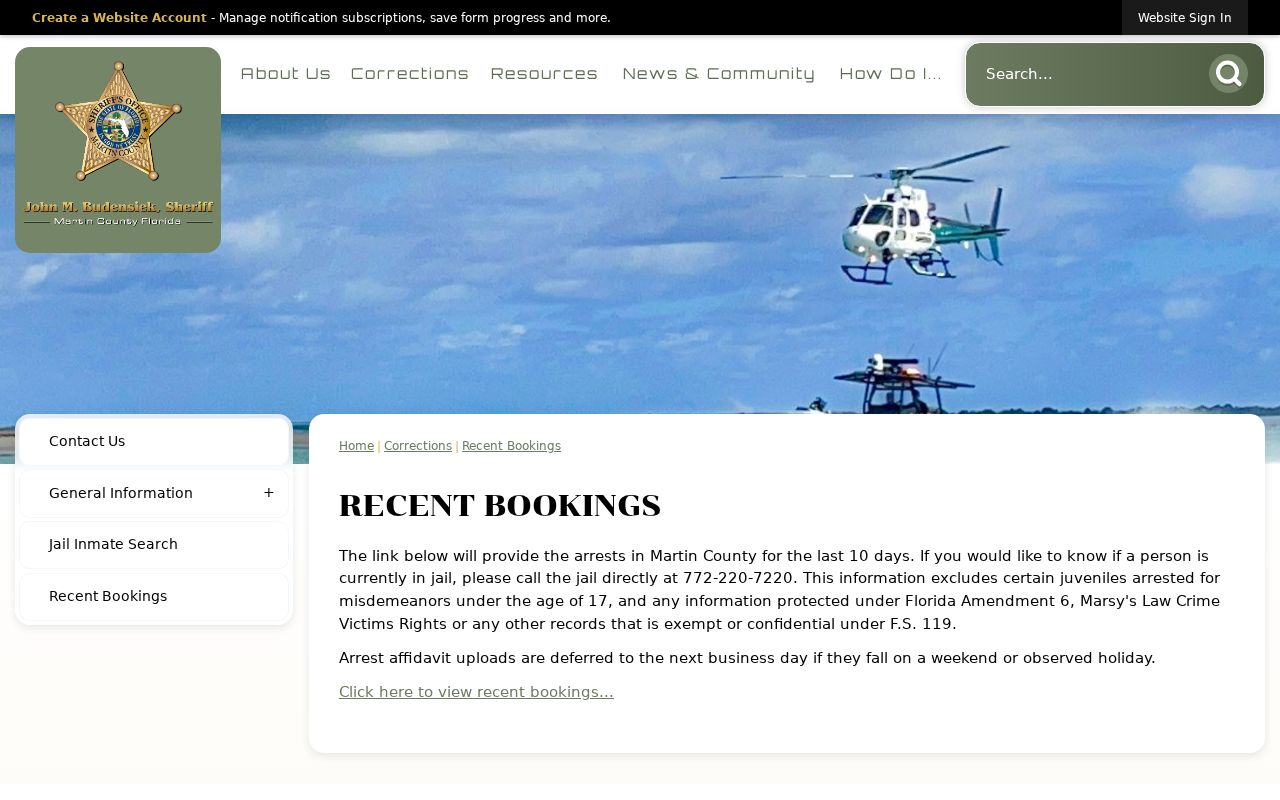
Call the current-inmate line when release or transfer may have changed since the last web update.
How to Look Up Martin County Arrests
Use the newest, narrowest Martin County source first, then widen the search. Record the booking number, agency, arrest date, and case or warrant number when displayed. Those keys make later requests more precise and help distinguish people with similar names.
- Check MCSO Recent Bookings for the ten-day window, then call 772-220-7220 to confirm current custody.
- Identify the arresting agency and request its incident or arrest affidavit. Stuart and Sewall's Point keep their own police reports.
- Search the Martin Clerk docket for a filed prosecution and its later disposition.
- Use the FDLE Florida Criminal History Record Check for older statewide public history, or free Personal Review for your own fingerprint record.
- Submit a narrow MCSO JustFOIA request when the online feed lacks the booking, affidavit, recording, or report sought.
Martin County Arrest Record Requests
The MCSO Records Unit is the main fallback for sheriff reports and older booking material. Requests can begin through JustFOIA, by mail with a self-addressed stamped envelope, at 800 SE Monterey Road on weekdays from 8 a.m. to 5 p.m., or by phone at 772-220-7050. The page lists a fax number but says requests are not fulfilled by fax.
The official records page sets out the local request route and limits.
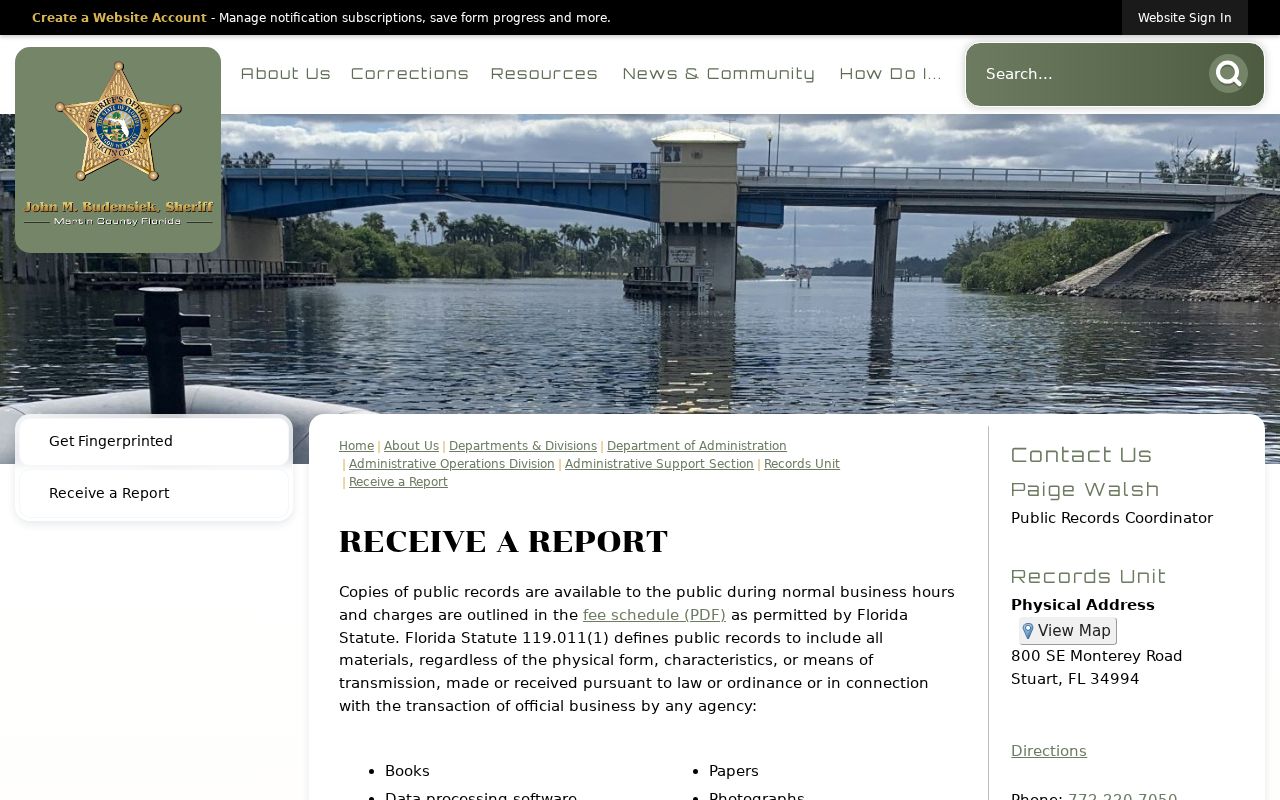
Include an approximate date, location, report type, and case or booking number when known.
MCSO Records Unit
800 SE Monterey Road
Stuart, FL 34994
772-220-7050
Weekdays, 8 a.m. to 5 p.m.
What a Martin County Arrest Record Shows
Fields vary between the agency report, jail profile, and public feed. A Martin County entry can identify the event and custody status, but it does not promise every police narrative or later court outcome. Protected victim details, some juvenile records, and exempt investigative material may be removed.
| Booking Number | Local identifier used to distinguish an intake event. |
|---|---|
| Booking Date & Time | When jail intake was recorded. |
| Arresting Agency | Office that created the arrest report. |
| Charges | Allegations recorded at intake, which may differ from filed counts. |
| Bond | Type and amount shown at that point in the case. |
| Booking Photograph | May be public when no exemption applies, but does not prove guilt. |
| Release Status | Custody or release information that can change after the snapshot. |
Using Martin County JustFOIA
The MCSO JustFOIA portal accepts a description of the record, incident date or range, address, and case or booking number. Florida law generally does not require a requester to give a name or reason, though contact details help with delivery and estimates. Keep the request number and security key after submission.
The portal is the sheriff's official online request and status channel.
A focused request reduces staff search time and avoids sweeping in records that need more redaction.
Recent Arrests and Booking Logs
Recent Bookings answers whether Martin County Jail recorded an intake during its short window. The jail telephone line answers whether the person remains in current custody. Older arrests need an agency request, the court docket, or FDLE history. A release can occur before a reader checks the page, so absence from the current view proves neither that no arrest occurred nor that the matter ended.
MCSO's jail services page also explains bond and custody procedures.
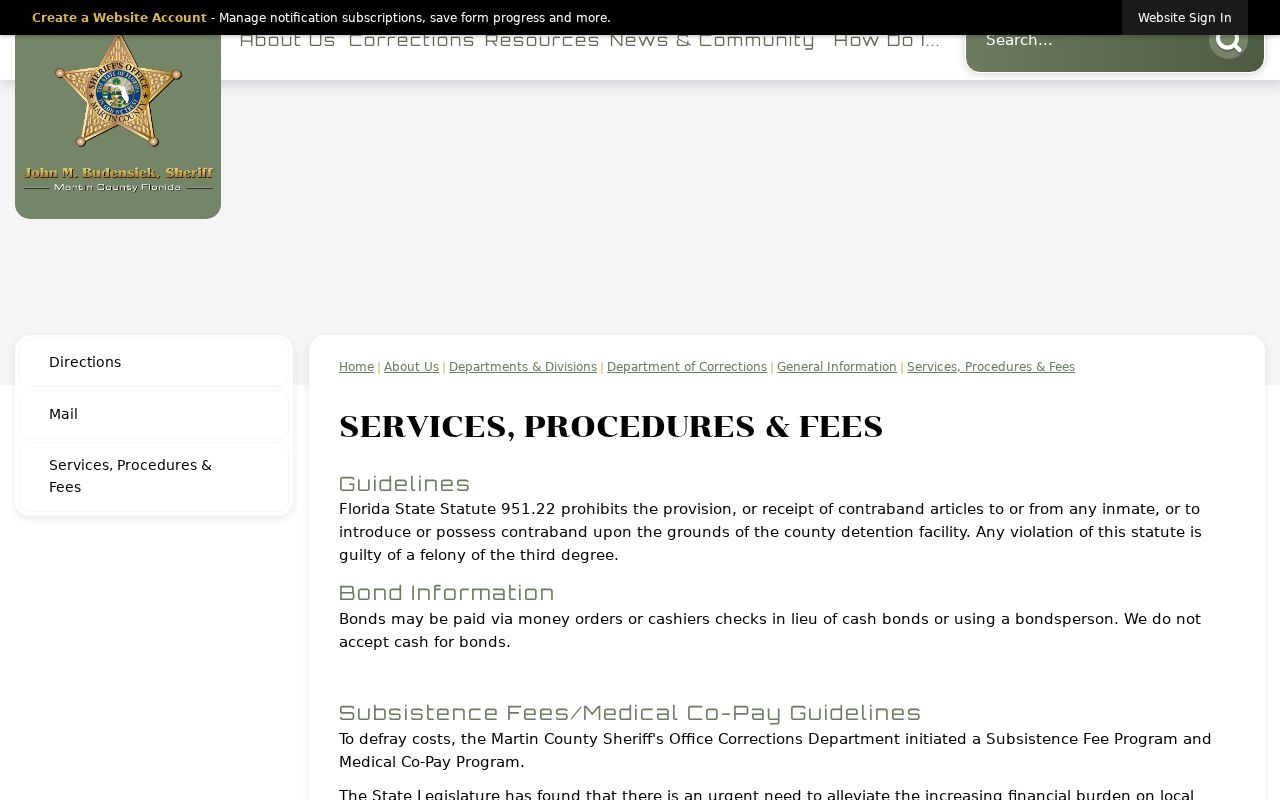
It clarifies that the jail accepts money orders or cashier's checks in place of cash bonds, or a bondsperson, and does not accept cash for bonds.
Martin County Arresting Agency Routes
For Stuart incidents, use the Stuart Police report request route at 830 SE Martin Luther King Jr Boulevard or call 772-287-1122. Sewall's Point Police can be reached at 1 S Sewall's Point Road, 772-781-3378, or sppd@sewallspoint.org. Indiantown law-enforcement records remain with MCSO rather than the Village Clerk.
State-road crashes or traffic arrests may belong to Florida Highway Patrol. Wildlife or waterway cases may originate with FWC. Federal arrests route to the arresting federal agency and the Southern District court docket, not to the sheriff's report files. Always follow the arresting agency field.
Martin County Booking Record Flow
After an arrest, jail staff establish identity, inventory property, photograph and fingerprint the person, enter charges and warrants, screen health and safety needs, and classify housing. The electronic fingerprint transaction then supports reporting to FDLE. A first-appearance judge reviews probable cause, counsel, release, and conditions. Each step creates a different record, and each may update at a different time.
Bond information is especially time-sensitive. A booking profile may show the amount set at intake, while a later order changes the terms. MCSO accepts money orders or cashier's checks in lieu of cash bonds, or use of a bondsperson. It expressly does not take cash for bonds. After disposition, the clerk may deduct court fines from a cash-bond refund before mailing the balance.
When the person later enters state prison or felony community supervision, use FDC Offender Search. It is not a substitute for Martin County Jail intake data. A pretrial detainee may never appear there, while a sentenced transfer may disappear from a local current-custody view.
Missing Martin County Arrest Details
Florida law requires review before an arrest record is released. Juvenile material, victim location or contact data, protected addresses, Social Security numbers, active-investigation details, and some domestic-violence information may be withheld or redacted. Martin County Jail also does not disclose immigration-hold information and directs those questions to ICE.
A blacked-out field is not proof that the whole report is secret. Ask the custodian to identify the exemption applied to the withheld portion and request the nonexempt remainder. Narrow wording helps. State the event date, place, agency, case number, and exact item sought, such as the arrest affidavit rather than every record tied to a name.
Ordinary copy and production charges can apply. Extensive use may bring a reasonable special-service charge based on actual labor or resource burden under section 119.07(4)(d). Ask for an estimate before authorizing a large request.
Arrests vs Convictions
An arrest states that an agency took action based on alleged facts. Only the court can enter a conviction. Florida public history can retain an arrest and its reported disposition even after dismissal, acquittal, or a withhold, so the matching Martin County criminal court case is essential context.
| Arrest Record | Conviction Record |
|---|---|
| Created by the arresting agency and jail | Entered by the court and reported by the clerk |
| Shows an arrest or booking occurred | Shows a legal finding of guilt |
| Lives in agency, jail, and FDLE systems | Lives in the clerk docket and reported state history |
| Can be followed by release, no filing, dismissal, or acquittal | Can be followed by sentence, appeal, or qualifying record relief |
Note: An arrest is not proof of guilt, and the filed disposition should be checked before drawing any conclusion.