
Criminal Cases in the Martin County Courts
Martin County sits in Florida's Nineteenth Judicial Circuit. Circuit Court hears felony prosecutions. County Court handles misdemeanors, criminal traffic matters, and county ordinance cases within its jurisdiction. Both local criminal dockets are maintained by the Martin County Clerk Criminal Division, with the main court operation at 100 SE Ocean Boulevard in Stuart. The clerk is the source for filed charges, motions, hearing events, judgments, sentences, and certified copies.
That division of work matters when a name search seems incomplete. A misdemeanor may sit in County Court while a felony arising from another event appears in Circuit Court. Municipal police departments create incident and arrest reports, but they do not keep the prosecution docket. The Martin County court file begins when a charging document reaches the clerk and then grows as the judge, attorneys, and clerk file case events.
Martin County Criminal Court Divisions
The same Stuart courthouse supports several distinct tracks. The felony division operates in Circuit Court, while three county-court assignments cover lower-level criminal work. Martin County also has Adult Felony Drug Court and Mental Health Court assignments. These programs do not erase the underlying docket. Their orders, status hearings, and outcomes appear in the case file when public.
| Martin court | Criminal work | Official contact |
|---|---|---|
| Circuit Court | Felonies and felony Drug Court matters | Clerk Criminal Division, 772-288-5576 |
| County Court | Misdemeanors, criminal traffic, and ordinance cases | Clerk Criminal Division, 772-288-5576 |
| Mental Health Court | Assigned qualifying County Court matters | Read the case docket for current assignment |
How to Search Case Records
The free Martin Court Records Search is the first stop for a public trial-court docket. Search by a party name when the case number is unknown. A full case number is more precise and can avoid same-name results. Choose the criminal or traffic category that fits the matter, then compare the filing date, division, judge, and charge rows before opening documents.
The official Martin search screen shows the county's direct route into public case records.
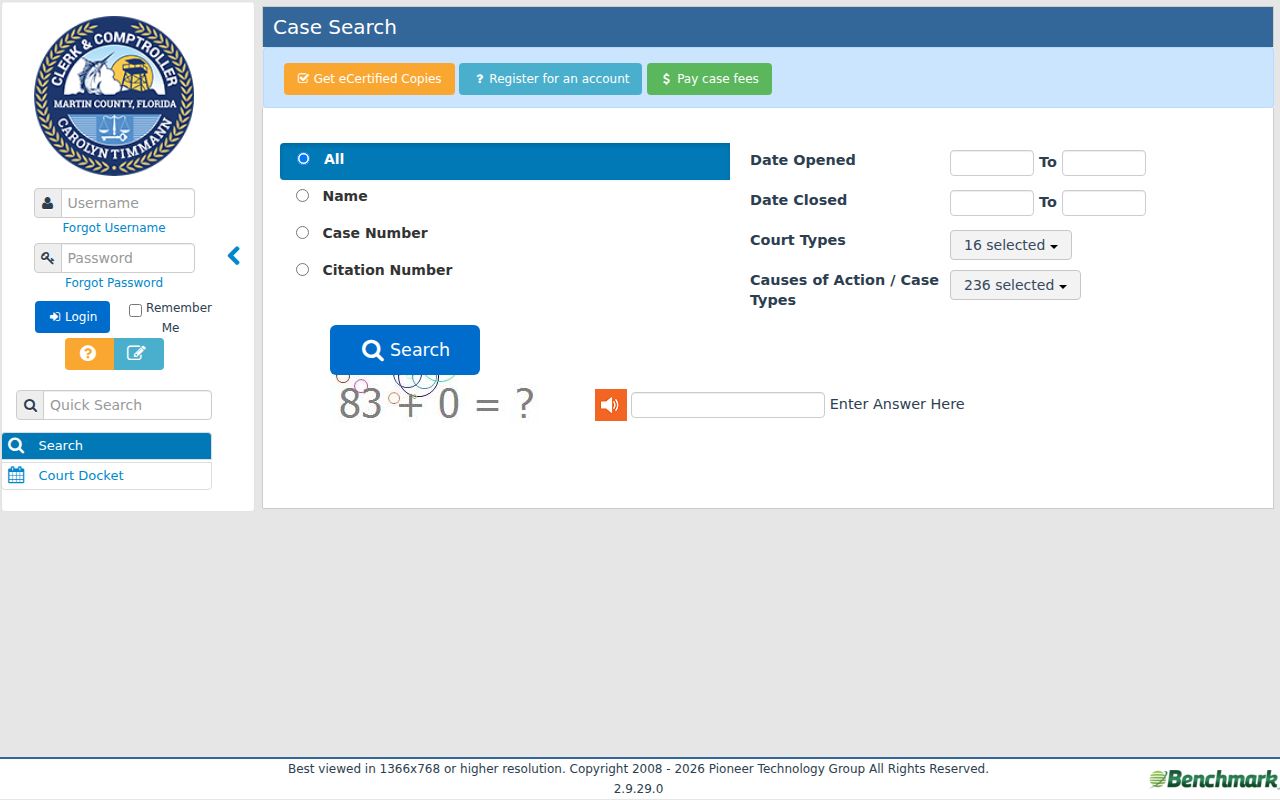
Its separate name and case-number paths support both broad discovery and precise retrieval.
- Open the Martin portal and select a party-name or case-number route.
- Enter the surname and given name, or preserve all punctuation in a known case number.
- Narrow a common name by filing dates, case category, middle name, or any displayed birth detail.
- Open the matching docket and read events in date order, including the information, plea, judgment, and sentence.
- Request a public copy or certified disposition from the clerk when an image is missing or formal proof is needed.
| Field Label | Type | Required | Notes |
|---|---|---|---|
| Last Name or Business Name | Text | Search-dependent | Try spelling variants. |
| First and Middle Name | Text | Optional | Narrows common surnames. |
| Case Number | Text | Alternate route | Keep the format shown on court notices. |
| Date of Birth | Date/text | Availability varies | Public input or display may be limited. |
| Filing Dates and Category | Date/select | Optional | Limit results by year and criminal case type. |
Martin County Criminal Court Copies
A missing image does not mean the filing is unavailable. Use the clerk's Court Records Request, email RecordRequest@martinclerk.com, mail a request to PO Box 9016, Stuart, FL 34995, call 772-288-5576, fax 772-288-5548, or visit the counter at 100 SE Ocean Boulevard. Name the case number, document, and preferred certification status.
The clerk's Criminal Division page gathers the official court-record and copy routes.
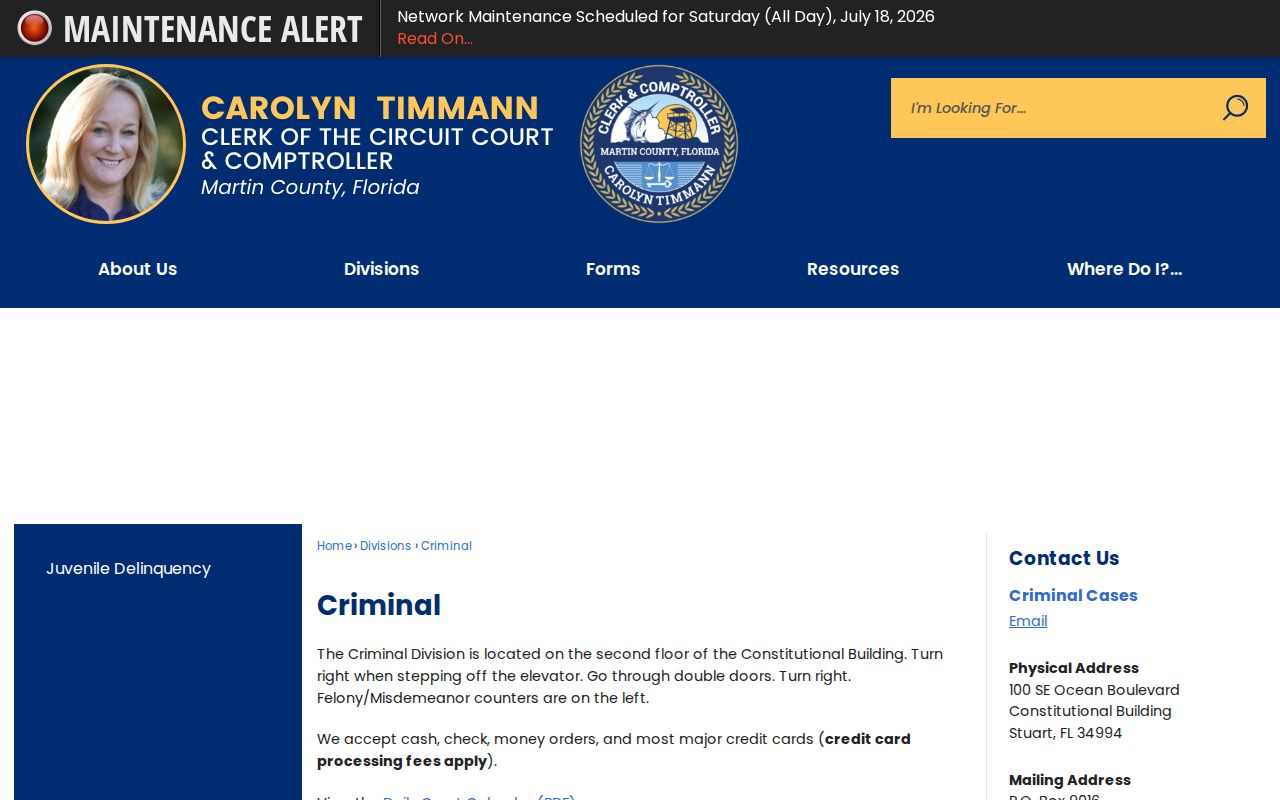
That office, rather than the arresting agency, certifies filed dispositions and court documents.
Court copies cost $1 per page, and certification costs $2 per document. Existing transcripts are $1 per page plus certification. Eligible older court audio costs $25 per CD for up to 60 minutes. Audio after June 2007 routes through Court Administration. Those routes preserve access when an online account cannot display a restricted image tier.
What the Martin Case File Shows
A Martin County criminal court file identifies the prosecution and records how each count moved. The docket is a date-ordered index, not the police narrative. It can show an arrest affidavit, information, notices, hearings, motions, plea, judgment, probation order, warrant or capias, and closure. Financial rows may also show court costs, payments, balances, and collections status.
| Case Number & Court | Identifies Circuit or County Court, filing year, division, and case sequence. |
|---|---|
| Charging Document | The information, indictment, or complaint states the formal filed counts. |
| Docket Entries | Lists filings, notices, hearings, motions, orders, warrants, and closure events by date. |
| Hearing Dates | Shows scheduled and completed court events when public. |
| Disposition & Judgment | Records the result of each count, such as conviction, dismissal, acquittal, or nolle prosequi. |
| Sentence & Conditions | Shows custody, probation, fines, costs, restitution, and other ordered terms. |
Martin County Criminal Case Outcomes
Similar-looking Martin docket terms have different legal effects. A nolle prosequi is the prosecutor's formal choice not to proceed on a count at that time. A dismissal ends a charge through court or prosecution action. An acquittal is a not-guilty result after trial. A withhold of adjudication means guilt was not formally adjudicated after a plea or finding, but it is not a dismissal.
- Disposition
- The outcome recorded for one charge.
- Docket
- The chronological list of case events and filings.
- Capias
- A court command to take a person into custody, often after a missed appearance.
- Closed
- A docket posture that does not, by itself, reveal whether the result was favorable.
Read the judgment and disposition for each count. Do not infer the result from the word closed, the original arrest charge, or a lone booking entry.
Martin County Drug Court Records
Adult Felony Drug Court follows a separate program track within the Nineteenth Judicial Circuit, and Judge Steven J. Levin's official assignment includes all Martin felony Drug Court cases. The underlying prosecution still remains a Circuit Court case. Public orders, status hearings, pleas, sanctions, and the final disposition appear through the clerk when they are not confidential.
Do not assume that a specialty-court assignment means the charge was dismissed. Read the docket through completion. A program entry, later violation, successful completion, amended sentence, or termination can change the case posture, and the judgment remains the clearest source for the legal result.
Stages of a Criminal Case
The State Attorney reviews probable-cause material after an arrest or notice to appear. The prosecutor may file an information, seek an indictment, reduce charges, divert the matter, or decline prosecution. A filed Martin County case can then move through arraignment, discovery, motions, pretrial conferences, a negotiated plea or trial, disposition, and sentencing. Appeals and probation violations add later events when applicable.
Case flow: Charges Filed › Arraignment › Pretrial › Plea or Trial › Disposition › Sentencing
The sequence is more useful than any single status label. A probation-violation affidavit may reopen activity in a closed prosecution and can lead to a capias, hearing, modification, or new sentence.
When Martin County Shows Only Arrest
A recent booking can appear before a Martin County criminal case. The jail posts an intake event, while prosecutors still review the allegations and decide whether to file. Search again after the intake period, using both the person's name and any case number printed on a notice. If no prosecution appears, contact the Clerk Criminal Division and the arresting agency rather than assuming the matter reached a final outcome.
The reverse can also occur. A court docket may show a local case before FDLE receives or matches the disposition. For a full case result, preserve the certified judgment or disposition. The separate Martin County arrest history resource explains the report and booking side of that record chain.
Access & Restrictions
Florida Rule of General Practice and Judicial Administration 2.420 governs access to judicial records. It differs from the ordinary agency-request process under Chapter 119. Public Martin County docket material may be viewed online, but victim contact information, protected addresses, Social Security numbers, account data, juvenile records, sealed cases, and confidential filings are withheld or redacted.
The Florida Supreme Court rules collection provides the controlling statewide access rule.
Rule 2.420 explains why a docket can remain visible while protected data or a document image does not.
An online view can also offer fewer document images than a role-approved account or clerk review. Ask the clerk about the exact case and filing when a docket row lacks an image. A valid sealing or expungement order changes public access, but an arrest does not vanish merely because a charge was dismissed. The court outcome remains the right source for understanding what the prosecution did.